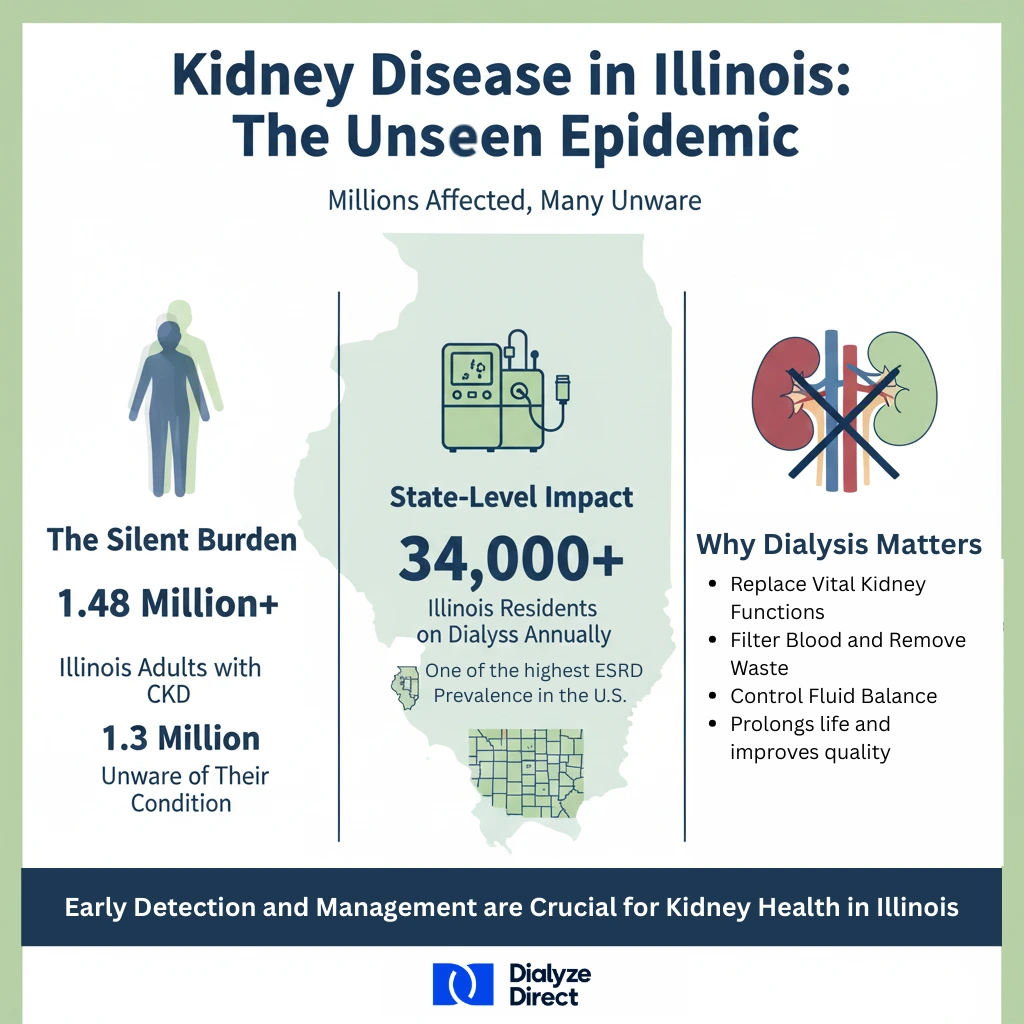
Kidney disease is silently affecting millions of lives across Illinois. State-level estimates indicate that approximately 1.48 million adults in Illinois are living with chronic kidney disease, and alarmingly, nearly 1.3 million are unaware of their condition. Illinois also carries one of the highest prevalences of end-stage renal disease (ESRD) in the United States, with more than 34,000 residents dependent on dialysis each year.
Every year, thousands of Illinois residents progress to kidney failure, making dialysis a medical necessity rather than a choice. Data from state and national renal networks show Illinois consistently ranks among the highest states for dialysis patients, particularly in urban centers like Chicago and surrounding counties.
Dialyze Direct provides home dialysis services in Illinois, helping seniors and patients with kidney failuredialyze safely in the comfort of their own homes. Our expert care team guides transition to home dialysis with staff-assisted home hemodialysis, training, and remote monitoring, improving kidney health, independence, and overall quality of life.
Living with kidney disease and ongoing dialysis treatment affects far more than lab numbers.
Patients experience fatigue, weakness, blood pressure changes, fluid overload, and complications related to vascular access, catheters, or the dialysis machine itself. Frequent hemodialysis sessions or peritoneal dialysis exchanges place continuous stress on the body.
Depression, anxiety, and fear are common among dialysis patients. Repeated trips to a dialysis center, loss of independence, and uncertainty about the future can make the dialysis experience overwhelming.

Traditional in-center hemodialysis often dictates a rigid dialysis schedule, limiting work, travel, and family time. Many patients with kidney failure report that their daily routine revolves around treatment days.
Dialysis care is expensive. Medicare spends over $90,000 per patient per year on kidney dialysis, and even with coverage, transportation, missed work, and caregiver time add strain. Families providing home dialysis help for caregivers often face burnout without proper support. This is where a shift toward home dialysis options is changing lives.
Home dialysis Illinois programs reflect a national paradigm shift in renal care, bringing treatment out of the clinic and into the comfort of your home.
Studies consistently show that dialysis at home can lead to:
Unlike traditional in-center dialysis, home dialysis services allow patients and families to personalize care in a supportive home environment.
| Feature | Home Dialysis | In-Center Hemodialysis |
| Frequency | More frequent, often 5 days per week (pursuant to physician’s order) | Typically 3 times per week (pursuant to physician’s order) |
| Location | Conducted in the comfort of the patient’s home | Performed at a clinic or dialysis center |
| Flexibility | High flexibility; patients can set schedules around daily life | Fixed schedule determined by the dialysis center |
| Environment | Familiar, comfortable home setting | Clinical, medical environment |
| Travel | No travel required | Requires regular travel to and from the center |
| Health Outcomes | Better blood pressure control and reduced fluid retention due to more frequent treatments | Effective treatment, though less frequent sessions may impact overall health between visits |
Dialyze Direct provides comprehensive home dialysis services designed around real patient needs. Our approach centers on personalized care, safety, and dignity, helping patients regain control of their lives.
Our goal is simple: help patients dialyze safely while maintaining independence, confidence, and comfort.
Patients perform dialysis at home using modern, patient-friendly equipment, including portable home hemodialysis machines when appropriate. This type of treatment allows for shorter, more frequent sessions, which many studies show can lead to:
Home hemodialysis also gives patients more control over when they dialyze, making it easier to maintain daily routines, attend medical appointments, enjoy family time, or manage work responsibilities.
Not every patient can manage dialysis alone, and they don’t have to.
Dialyze Direct offers assisted home hemodialysis, where trained professionals help with:
This is especially valuable for:
This model brings high-quality dialysis care directly to Illinois patients who may not be able to manage treatment independently.

Every patient’s kidney care journey is unique, but many more people qualify for home dialysis today than in the past. If your nephrologist recommends home hemodialysis, and you want a program that provides professional support, Dialyze Direct can help you get started.
You may be a good candidate if:
If you’re unsure, our team provides a simple evaluation to check eligibility and answer your questions.
Illinois has a large senior population, especially in and around Chicago, Naperville, Joliet, Aurora, Rockford, and Peoria. For many older adults, the demands of traveling to a clinic three days a week are simply too difficult.
With home dialysis for seniors, patients can:
Family members and caregivers often feel relieved knowing they are not responsible for operating the equipment or handling emergencies alone.
Dialysis affects the whole household. Spouses, adult children, and family caregivers often carry a heavy emotional and physical load. They want their loved one to be safe, but also want to manage daily life.
Caregivers no longer feel alone in navigating kidney care.
Many patients assume home dialysis costs more than in-center treatment, but in most cases, that’s not true. Home dialysis is typically covered by a wide range of insurance plans, and Dialyze Direct works closely with families to help them understand benefits and reduce out-of-pocket expenses.
Most Illinois patients receive coverage through:
We also work with a broad network of insurance providers, including:
During Medicare’s Open Enrollment Period, many families ask important questions such as:
Our insurance specialists guide patients and caregivers through each step, reviewing benefits, verifying eligibility, and explaining how home dialysis coverage works in Illinois. The goal is always to make the financial process simple, transparent, and stress-free.
Wondering how to get home dialysis? Dialyze Direct makes it straightforward:
From start to finish, patient care remains our priority.
Dialyze Direct proudly supports home dialysis Illinois patients in major cities and surrounding areas, including:
We help ensure consistent, high-quality dialysis services wherever patients live.
For many patients with chronic kidney disease or end-stage renal disease, home dialysis offers a chance to reclaim life, greater flexibility, fewer disruptions, and meaningful time with loved ones.
With Dialyze Direct, you are not just another patient in a dialysis center. You are supported by a dedicated renal care team focused on personalized treatment, safety, and long-term well-being.
Freedom with home dialysis is possible, and Dialyze Direct is here to help you achieve it.
Dialysis should support life, not take over your calendar.
If you or your loved one are exploring home dialysis in Illinois, we’re here to answer questions, explain options, and guide you through the process.
Call us today at (732) 732-0052 or schedule your free consultation online to start your journey toward safe, convenient, and personalized home dialysis.
We’re always here for you. Just a phone call away, whenever you need us.

Your primary contact, providing expert clinical support throughout your journey.

Your nephrologist, overseeing your care plan and dialysis treatment protocol.

Here to help you
thrive, not just survive.

Guiding you on kidney-friendly nutrition and necessary supplements.

Making sure you have what you need, when and where you need it.
The content draws from state health reports, national renal data systems, and advocacy profiles for factual claims on CKD prevalence, ESRD rates, and dialysis dependency. Below is a curated list of primary sources supporting key statistics like 1.48 million adults with CKD and over 34,000 on dialysis.