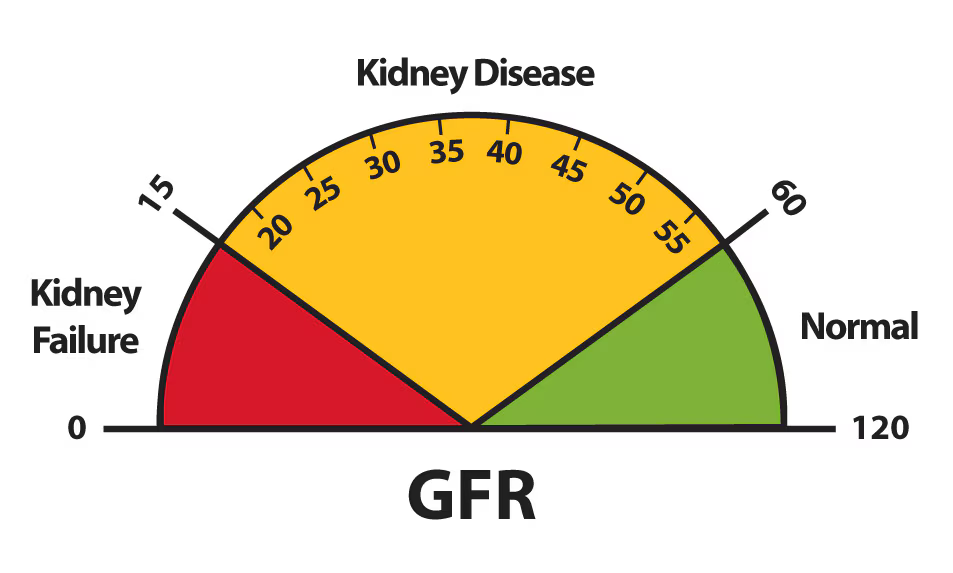
Did you know that chronic kidney disease (CKD) affects approximately 37 million adults in the United States, according to the Centers for Disease Control and Prevention (CDC)? An estimated 90% of people with CKD are unaware they have the condition, often because symptoms may not appear during the early stages.
That is why kidney function tests, including the estimated glomerular filtration rate (eGFR) test and creatinine blood test, are important for detecting potential kidney problems early and monitoring kidney health.
If CKD progresses to kidney failure, treatment options such as dialysis or a kidney transplant may become necessary. Home dialysis is one option for eligible patients, offering the opportunity to receive treatment at home with support from their healthcare team. Learn more about home dialysis here.
The estimated glomerular filtration rate (eGFR) is an important indicator of how well your kidneys filter waste and excess fluid from your blood. It is generally calculated using your blood creatinine level, age, and sex.
An eGFR blood test helps healthcare professionals assess kidney function, identify possible signs of chronic kidney disease, and monitor changes over time. However, a single result cannot always confirm kidney disease. Doctors may also consider urine albumin levels, medical history, and repeat test results.
eGFR is usually reported in milliliters per minute per 1.73 square meters (mL/min/1.73 m²). The following table explains the general eGFR categories used to assess kidney function.
| eGFR Level | General Category |
|---|---|
| 90 or higher | Normal or high eGFR |
| 60–89 | Mildly decreased eGFR |
| 30–59 | Moderately decreased eGFR |
| 15–29 | Severely decreased eGFR |
| Less than 15 | Kidney failure range |
An eGFR of 60–89 does not automatically mean someone has CKD. Evidence of kidney damage, such as elevated urine albumin, may also be needed. In general, chronic kidney disease involves kidney damage or reduced kidney function that persists for at least three months.
A low eGFR may indicate reduced kidney function, but the result should be interpreted alongside other tests and your medical history. Your healthcare provider may recommend additional blood or urine tests to understand what the result means.
Kidney disease often progresses silently, making early detection crucial. One of the best ways to assess kidney function is by using an eGFR calculator, which estimates how well your kidneys are filtering waste from your blood.
An An eGFR calculator is a tool that estimates kidney function based on specific health measurements. Depending on the calculator, it may use the following information:
The estimated result can help healthcare professionals assess kidney function, evaluate possible CKD, and monitor changes over time. An eGFR calculator does not replace laboratory testing or a medical assessment.
The most commonly used CKD-EPI equation estimates eGFR based on the following formula:
| eGFR Level (mL/min/1.73 m²) | General Interpretation |
|---|---|
| 90 or higher | Normal or high filtration; other evidence is needed to identify CKD |
| 60–89 | Mildly decreased filtration |
| 30–59 | Moderately decreased filtration |
| 15–29 | Severely decreased filtration |
| Less than 15 | Kidney failure range |
These categories are not a diagnosis on their own. For example, an eGFR below 60 that persists for at least three months may indicate CKD, while urine albumin and other findings help determine the extent of kidney damage.
If your eGFR is lower than expected, your healthcare provider may recommend repeat testing, a urine albumin-to-creatinine ratio (UACR), or other investigations.
Take control of your kidney health today. Use This eGFR Calculator to quickly estimate your kidney function and understand your results.
A creatinine blood test measures the amount of creatinine in your blood, a waste product from the normal breakdown oA creatinine blood test measures the amount of creatinine in your blood. Creatinine is a waste product produced during normal muscle activity, and healthy kidneys remove it from the bloodstream.
Higher-than-expected creatinine levels may indicate that your kidneys are not filtering waste as efficiently as expected. However, creatinine levels can also be affected by muscle mass, diet, certain medications, and other factors.
Typical adult creatinine reference ranges may include:
These ranges can vary between laboratories. Your results should be compared with the reference range provided by the laboratory and interpreted by your healthcare provider.
This blood test measures the amount of waste product in your blood called urea nitrogen. High BUN levels may suggest kidney disease, dehydration, or high protein intake.
TheThe urine albumin-to-creatinine ratio (UACR) test measures the amount of albumin, a protein, in your urine relative to creatinine. Healthy kidneys usually prevent significant amounts of albumin from passing into the urine.
An elevated UACR may be an early sign of kidney damage, even when eGFR is still within the normal range.
General UACR categories:
A healthcare provider may recommend repeating the test to confirm an abnormal result. UACR and eGFR are often used together to assess kidney health and monitor CKD.
This test measures how effectively your kidneys remove creatinine from your blood over a 24-hour period. It provides further insights into glomerular filtration rate (GFR) and kidney function.
If other test results suggest kidney disease, a kidney biopsy may be necessary. This involves taking a small sample of kidney tissue to identify the cause of your kidney disease.
Chronic kidney disease is commonly classified into five stages based on eGFR and evidence of kidney damage. The stage helps healthcare professionals assess kidney function and plan appropriate monitoring and treatment.
| Stage | eGFR Level (mL/min/1.73 m²) | What It Means |
|---|---|---|
| Stage 1 | 90 or higher | Normal or high eGFR with evidence of kidney damage |
| Stage 2 | 60–89 | Mildly decreased eGFR with evidence of kidney damage |
| Stage 3 | 30–59 | Moderately decreased kidney function |
| Stage 4 | 15–29 | Severely decreased kidney function |
| Stage 5 | Less than 15 | Kidney failure range |
Stages 1 and 2 require evidence of kidney damage, such as persistent albumin in the urine, to establish CKD. For stages 3–5, the reduced eGFR must generally persist for at least three months to meet the criteria for chronic kidney disease.
Understanding your eGFR, creatinine, and urine albumin results can help you and your healthcare provider monitor changes in kidney function and determine appropriate next steps.
Kidney disease often develops slowly and silently, with symptoms appearing in later stages. Identifying risk factors early can help prevent or delay kidney damage. Several conditions and lifestyle choices increase the likelihood of developing chronic kidney disease (CKD) or kidney failure.
Kidney stones can sometimes obstruct urine flow and cause complications. Repeated kidney infections or untreated urinary tract problems may also contribute to kidney damage in certain cases.
Persistent symptoms, recurrent infections, or suspected urinary obstruction should be assessed by a healthcare professional.
A family history of kidney disease may increase a person’s risk, particularly when a close relative has an inherited kidney condition.
Polycystic kidney disease (PKD) is a genetic condition in which fluid-filled cysts develop in the kidneys. Over time, these cysts can affect kidney function.
People with a family history of kidney disease should discuss their risk and possible screening needs with their healthcare provider.
A nephrologist specializes in diagnosing and treating kidney conditions. Your healthcare provider may recommend a kidney specialist if your test results or medical history suggest a need for further evaluation.
Possible warning signs and findings include:
These signs do not always indicate kidney disease, but they should not be ignored. Seek medical advice if you notice concerning symptoms or receive abnormal kidney function results. Your healthcare provider can determine whether repeat testing or referral to a nephrologist is appropriate.
When kidney function declines to the point of failure, hemodialysis is the most effective and widely recommended treatment. This process removes waste, excess fluids, and toxins from the blood, performing the vital filtration work that failing kidneys can no longer manage.
Many patients are now choosing home hemodialysis for its added convenience and effectiveness.
Worried about the cost of dialysis? Many insurance plans cover dialysis treatments. Learn more about dialysis insurance coverage here.
Peritoneal dialysis (PD) is another option where a special fluid is introduced into the abdomen to remove toxins and excess fluids. While PD offers more flexibility and does not require a machine during the treatment, it may not be suitable for everyone due to:
For most individuals with chronic kidney disease, hemodialysis remains the safer, more effective, and more widely supported treatment option. Consulting with a nephrologist can help determine the best approach for managing kidney failure effectively.
Kidney disease can develop without obvious symptoms, but regular testing can help identify potential problems early. If you have diabetes, high blood pressure, a family history of kidney disease, or other risk factors, ask your healthcare provider whether kidney function screening is appropriate.
Blood tests such as eGFR and creatinine, along with urine albumin testing, provide important information about kidney health. Understanding these results can help you discuss monitoring and treatment options with your healthcare team.
For people with kidney failure, dialysis can help replace some of the functions of healthy kidneys. Home hemodialysis may provide additional flexibility for eligible patients, depending on their treatment plan and support needs.
Worried about the cost of dialysis? Insurance coverage varies, so check your specific plan and discuss available options with your healthcare team.
Taking proactive steps to monitor kidney health, manage existing conditions, stay physically active, and follow your healthcare provider’s advice can help support your overall well-being.
Information contained in this blog is for informational or educational purposes only and does not substitute professional medical advice or consultations with healthcare professionals. The content is not intended to be comprehensive or exhaustive, and it does not apply to any specific individual’s medical condition. Always refer to the personalized information given to you by your doctor, or contact us directly.

Driven, adaptable, and passionate about personal and professional growth, I bring a unique blend of creativity, problem-solving, and commitment to everything I do. With a strong background in [insert field or industry], I thrive in fast-paced environments where innovation and collaboration are key. I take pride in building strong relationships, delivering high-quality results, and constantly seeking new ways to learn and improve.
Throughout my journey, I’ve embraced challenges as opportunities for growth and continually pushed myself to exceed expectations. I’m highly organized, detail-oriented, and never shy away from taking initiative. Whether working independently or as part of a team, I believe in maintaining a positive attitude and a strong work ethic.